

Window Boxes in Charleston, SC: A Blooming Tradition Rooted in History
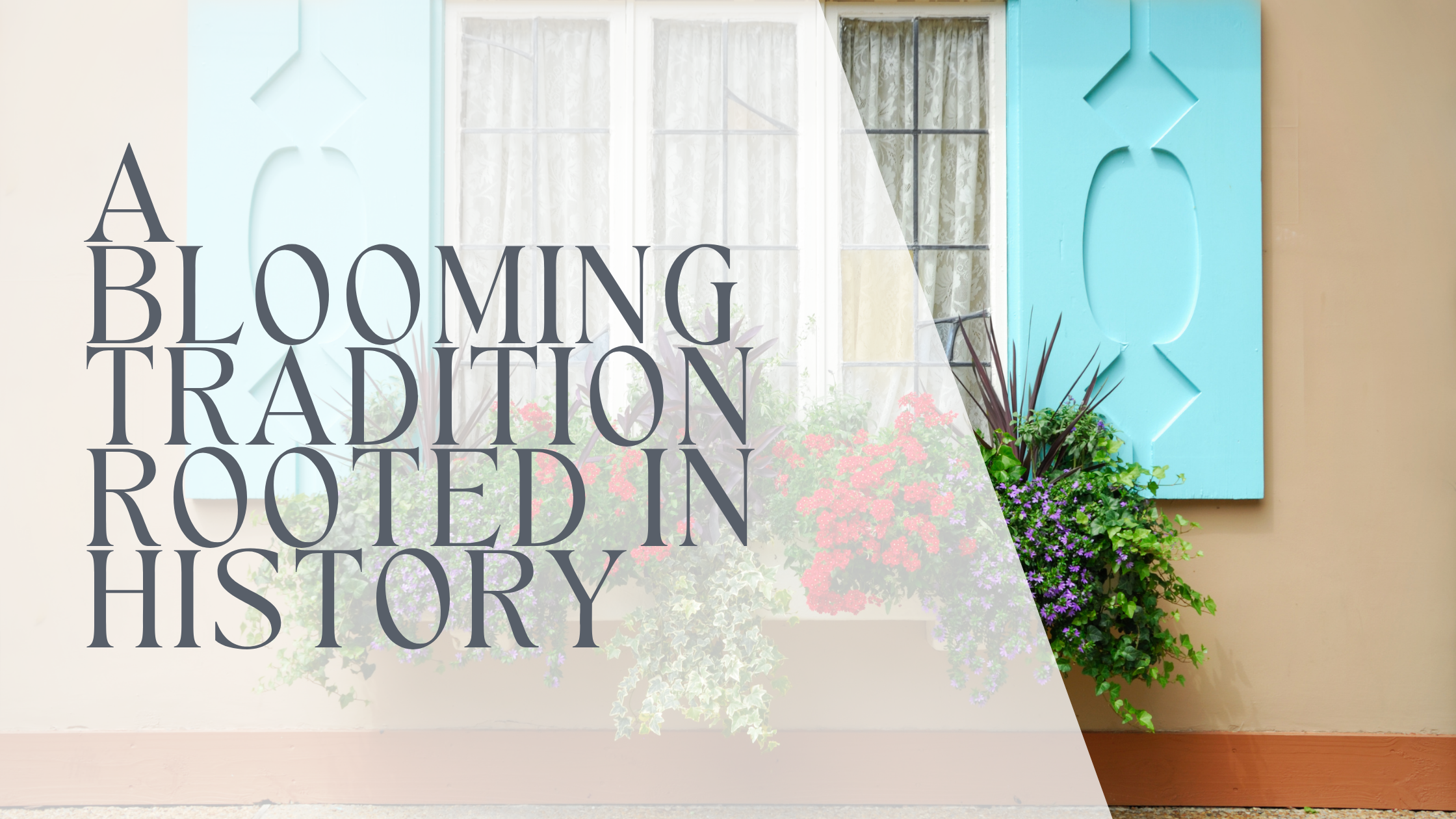
If you've ever strolled down a side street in Charleston, South Carolina — past the pastel-painted row houses, the wrought iron gates, and the lush hidden gardens — you've almost certainly stopped to admire a window box. Spilling over with petunias, trailing ivy, sweet potato vine, or maybe a tidy row of fresh herbs, Charleston window boxes are one of the city's most charming and recognizable details.
But these little gardens have a history that goes far deeper than Southern charm. Window boxes are, in fact, one of the oldest gardening traditions in the world.
The Ancient Origins of Window Boxes
Long before they became an Instagram-worthy detail on a Charleston single house, window boxes were a matter of survival.
The earliest evidence of container gardening dates back to ancient Rome — around the first century B.C. — when many Romans lived stacked on top of one another in crowded urban housing not unlike modern apartments. Without yards, without space, without resources, lower-class Roman families used window boxes as an economical way to grow food and medicine right outside their windows. Roman wives, in particular, were known to keep herb boxes close to the window for easy access while cooking and healing. Sound familiar? That story you may have heard — about reaching out the kitchen window to snip fresh herbs for dinner — turns out to be historically true, and thousands of years old.
The Roman naturalist Pliny the Elder even wrote nostalgically about villagers whose windows overflowed with colorful plantings. It was clearly a beloved custom even then.
Over time, as Rome's influence spread across Europe, so did the window box. What began as a practical solution to urban crowding gradually evolved into something more beautiful. Flowers replaced some of the vegetables — roses, lilies, violets, and pansies became favorites — and the window box began its long transformation from kitchen garden to decorative art form.
Window Boxes Across Europe
By the 17th and 18th centuries, window boxes had taken root across Europe, each region developing its own distinctive style:
France evolved the window box into elegant wrought iron containers, sometimes so spacious they functioned almost like small balconies.
England favored wire hay baskets mounted to cottage walls, overflowing with trailing flowers.
Italy continued the terra cotta tradition, with rustic clay boxes that still define the look of Tuscan and Roman streetscapes today.
Germany, Holland, and Ireland each developed their own regional styles, turning window boxes into a point of civic and personal pride.
The Victorian era, in particular, was a turning point. Mass production made terracotta and metal planters affordable to the middle class for the first time, and window boxes became nearly ubiquitous across Europe's cities. They were both practical — a way to grow herbs and vegetables in tight quarters — and deeply decorative, a connection to nature in the heart of dense urban environments.
Window Boxes Come to America
Window boxes crossed the Atlantic with European colonists and quickly found a home in America's early cities. In places like Boston's Beacon Hill, where homes were built flush to the street with little or no yard, window boxes became the logical solution for kitchen gardens. Homeowners would plant herbs just outside the window — close enough to reach, practical enough to feed a family.
In the late 19th and early 20th centuries, window gardening took on an additional dimension in American cities, becoming part of a broader civic beautification movement. Women's groups promoted window gardens as a way to bring color, order, and a sense of community pride to dense urban neighborhoods. "Gardens in a box," as early advocates called them, were seen as a way to connect the private home to the public street — a gift to the passerby as much as the homeowner.
Charleston, SC: A City Made for Window Boxes
Few places in America are better suited to window boxes than Charleston, South Carolina — and that's not an accident.
Charleston's historic architecture, with its iconic single houses, double piazzas, and narrow lots, was practically designed with window boxes in mind. The city's mild climate allows for year-round planting, meaning a well-tended window box in Charleston can be a living, changing work of art through every season. The long, warm growing season supports lush, trailing plants that spill dramatically over the edges of boxes — the kind of overgrown abundance that looks effortless but takes real care.
Walk down any street in the French Quarter, Harleston Village, Ansonborough, or South of Broad, and you'll see window boxes that have been tended for generations. Some are overflowing with seasonal flowers — geraniums, petunias, and sweet alyssum in spring and summer; ornamental kale and pansies in fall and winter. Others hold fragrant herbs: rosemary, basil, thyme, and mint, nodding to that ancient Roman tradition of the kitchen garden outside the window. Charleston's window boxes are as varied as the city itself — some formal and architectural, some wild and romantic, some simple and sweet.
They are, in their own quiet way, a form of storytelling. Each one says something about the person who tends it, the history of the house it adorns, and the neighborhood it belongs to.
What to Plant in a Charleston Window Box
If you're inspired to start your own window box garden here in the Lowcountry, the good news is that Charleston's climate is forgiving and generous. A few tips for local success:
Spring & Summer: Geraniums, lantana, pentas, sweet potato vine, petunias, and vinca all thrive in the heat and humidity. For herbs, basil, rosemary, and mint do beautifully with good drainage and full sun.
Fall & Winter: Swap summer annuals for pansies, ornamental kale, dusty miller, and snapdragons. Rosemary and thyme carry through beautifully into cooler months.
Year-round: Trailing ivy, creeping Jenny, and sweet potato vine add lush texture in any season. Ferns love Charleston's humidity and add a classic Southern touch.
The key to a thriving window box in the Lowcountry is drainage. Charleston summers are hot and wet, and roots that sit in soggy soil won't survive. Always use a quality potting mix, ensure your box has drainage holes, and water consistently but not excessively.
A Living Piece of History
The next time you pause on a Charleston sidewalk to admire a window box — the way the petunias catch the afternoon light, the way the rosemary spills over the edge, the way the whole thing transforms a plain facade into something alive — remember that you're looking at a tradition stretching back more than two thousand years.
From ancient Rome to Victorian England to the streets of the Holy City, the window box has always been about the same thing: the human desire to grow something beautiful, even in a small space. To reach out the window and touch something green. To offer a little color to the world passing by.
Charleston does it better than most. And we're here for it.
